
Minnesota's SAF Economy Is Open for Business - Flight Plan volume 1
Minnesota's SAF Economy Is Open for Business
Welcome to the inaugural issue of Flight Plan, a new briefing from the Minnesota SAF Hub on how we’re building a sustainable aviation fuel industry and market from Minnesota, for the world.
We’ll be in your inbox quarterly, with occasional special editions when we have something big to share. And today, we have something big to share.
Minnesota’s SAF Economy Takes Flight
The completion of a new commercial-scale blending facility serving MSP Airport marks a major milestone in Minnesota’s strategy to build an industrial-scale SAF economy.
Three years ago, the Minnesota SAF Hub set out with an ambitious goal: build an industrial-scale sustainable aviation fuel economy in Minnesota.
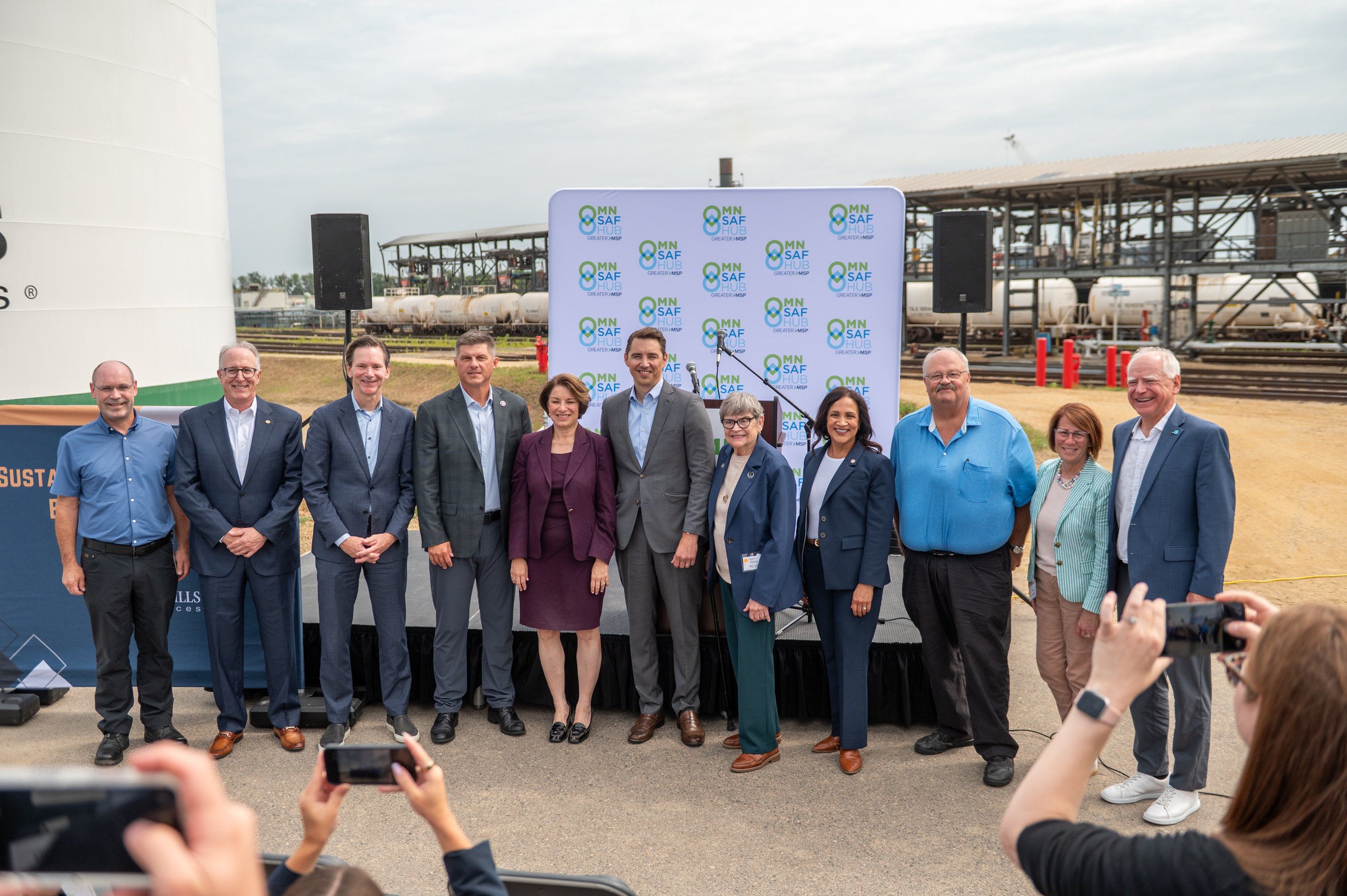
On Friday, July 24, we reached a major milestone.
A new SAF blending facility at Flint Hills Resources’ Pine Bend Refinery is now complete, creating the infrastructure needed to blend, test and certify SAF locally and deliver it directly to Minneapolis–Saint Paul (MSP) International Airport at commercial scale.
The facility can accommodate approximately 30 million gallons of neat SAF annually, using repurposed refinery tanks, a new rail unloading system, a state-of-the-art lab, underground infrastructure and the existing 10-mile pipeline connecting Pine Bend directly to MSP Airport.
Why blending matters
SAF is a safe and certified alternative jet fuel that can reduce lifecycle carbon emissions compared with conventional jet fuel. But producing SAF is only one part of getting it onto an airplane.
Before neat SAF enters the airport fuel supply, it must be blended with conventional jet fuel, tested and certified. Until now, few airports in North America had the infrastructure to do that locally at commercial scale.
Now Minnesota does.
That changes what is possible here. SAF can now move into Minnesota, through Pine Bend and directly to MSP Airport in commercial volumes. Minnesota's nation-leading SAF tax credit can be put to work. And producers considering where to bring new SAF supply to market now have a practical path to customers at one of the nation's busiest airports.
Building a market, together
The blending facility matters because it keeps Minnesota’s SAF strategy on track. But it also demonstrates the larger idea behind the Minnesota SAF Hub.
Making the promise of SAF real is not something that any one company, government or institution can achieve alone. Scaling it requires a combination of supply, demand, infrastructure, policy, investment and innovation.
That is what partners across Minnesota have spent the past three years building: airlines and corporate customers creating demand; policymakers establishing competitive incentives; farmers, researchers and producers developing new feedstocks and production pathways; and infrastructure partners creating the physical systems needed to move fuel from producer to airplane.
In September 2024, Minnesota demonstrated that this value chain could work when the first shipment of blended SAF arrived at MSP and powered Delta Air Lines’ first commercial flight in North America fueled in part by SAF made from winter camelina. The new blending facility takes the next step: moving Minnesota from demonstration toward a functioning commercial market.
As GREATER MSP President and CEO Peter Frosch put it at Friday’s celebration, “This is the moment Minnesota’s SAF economy begins.”
What comes next
Minnesota now has a critical piece of infrastructure needed to bring SAF into the state and deliver it to MSP at commercial scale. The next horizon is bigger: producing SAF here in Minnesota, using the state’s feedstocks, infrastructure, research capabilities and industrial strengths, and exporting Minnesota-made fuel to markets across the U.S. and Europe.
That means continuing to grow demand, capitalizing and siting production projects, aggregating and processing feedstocks, unlocking investment, and strengthening federal policy. That’s how we will expand economic opportunity across Minnesota while solving one of aviation’s greatest challenges.
Three years ago, this was a plan.
Now, it’s happening.
Click below to read more about the milestone and what it means for Minnesota.